Introduction
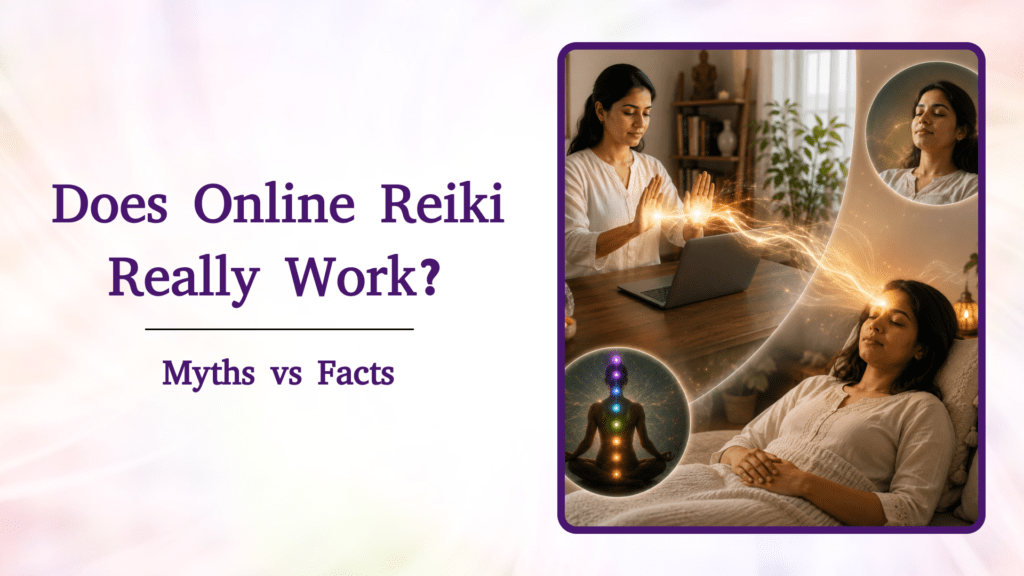
Skepticism around online Reiki is common, and understandably so — it challenges the assumption that healing requires physical touch. But practitioners and long-time students consistently report genuine results from remote sessions. Here’s an honest look at the myths, the reasoning behind distance healing, and real practitioner experiences.
Common Myth 1: Reiki Requires Physical Touch to Work
Reiki is understood as an energy practice, not a physical therapy. Traditional teachings describe energy as unbound by physical distance, which is the foundation for distance healing techniques taught at higher Reiki levels.
Common Myth 2: Online Reiki Is Just a Placebo
While the placebo effect is a valid consideration in any wellness practice, many practitioners report specific, consistent sensations — warmth, tingling, or relaxation — during remote sessions, similar to in-person experiences.
Common Myth 3: You Can’t Really Learn Reiki Without Physical Attunement
Level 2 Reiki training traditionally includes distance healing symbols specifically designed to work without physical presence, showing that remote practice has long been part of authentic Reiki teaching, not a modern shortcut.
What the Broader Wellness Conversation Says
Energy healing practices, including Reiki, exist within the complementary and alternative medicine space. They aren’t positioned as scientifically proven medical treatments, but rather as practices many people find genuinely valuable for relaxation, stress relief, and emotional wellbeing alongside conventional care.
What Practitioners Actually Report
- Noticeable relaxation and reduced stress after remote sessions
- Physical sensations similar to in-person Reiki, like warmth or tingling
- Improved sleep and emotional clarity following consistent practice
- A genuine sense of connection with the practitioner despite physical distance
How to Approach Online Reiki With Realistic Expectations
Approaching online Reiki as a complementary wellness practice, rather than a guaranteed cure, leads to a healthier, more honest experience.
Consultation services at Aatmbodh can help you understand what to realistically expect before starting.
Key Takeaways
- Reiki is traditionally understood as an energy practice not limited by physical distance.
- Distance healing symbols have long been part of authentic Reiki Level 2 training.
- Many practitioners report consistent physical sensations during remote sessions.
- Reiki is best approached as a complementary wellness practice, not a medical cure.
- Realistic expectations lead to a more honest, meaningful healing experience.
Frequently Asked Questions
Can Reiki really be sent over long distances?
Traditional Reiki teaching includes distance healing techniques specifically designed for this purpose, taught as part of Level 2 training.
Is there scientific proof that online Reiki works?
Reiki, in any format, exists within complementary wellness practices rather than clinically proven medicine; many people still find genuine value in it alongside conventional care.
Why do some people feel sensations during remote Reiki sessions?
Practitioners report physical sensations like warmth or tingling during remote sessions, similar to those experienced in-person, though individual experiences vary.
Should online Reiki replace therapy or medical treatment?
No, it’s best approached as a complementary practice alongside, not a replacement for, professional medical or mental health care.
Is online Reiki suitable for skeptics?
Yes, approaching it with an open but realistic mindset, focused on relaxation and wellbeing rather than guaranteed outcomes, works well for skeptical newcomers too.
Conclusion
Online Reiki isn’t a shortcut or a modern gimmick — distance healing has genuine roots in traditional Reiki teaching. Whether it ‘works’ for you is best explored with realistic expectations and an open mind.
Curious to experience it yourself? Explore Aatmbodh’s healing services or book a consultation to learn more.